
Liberatum Culture
10:06
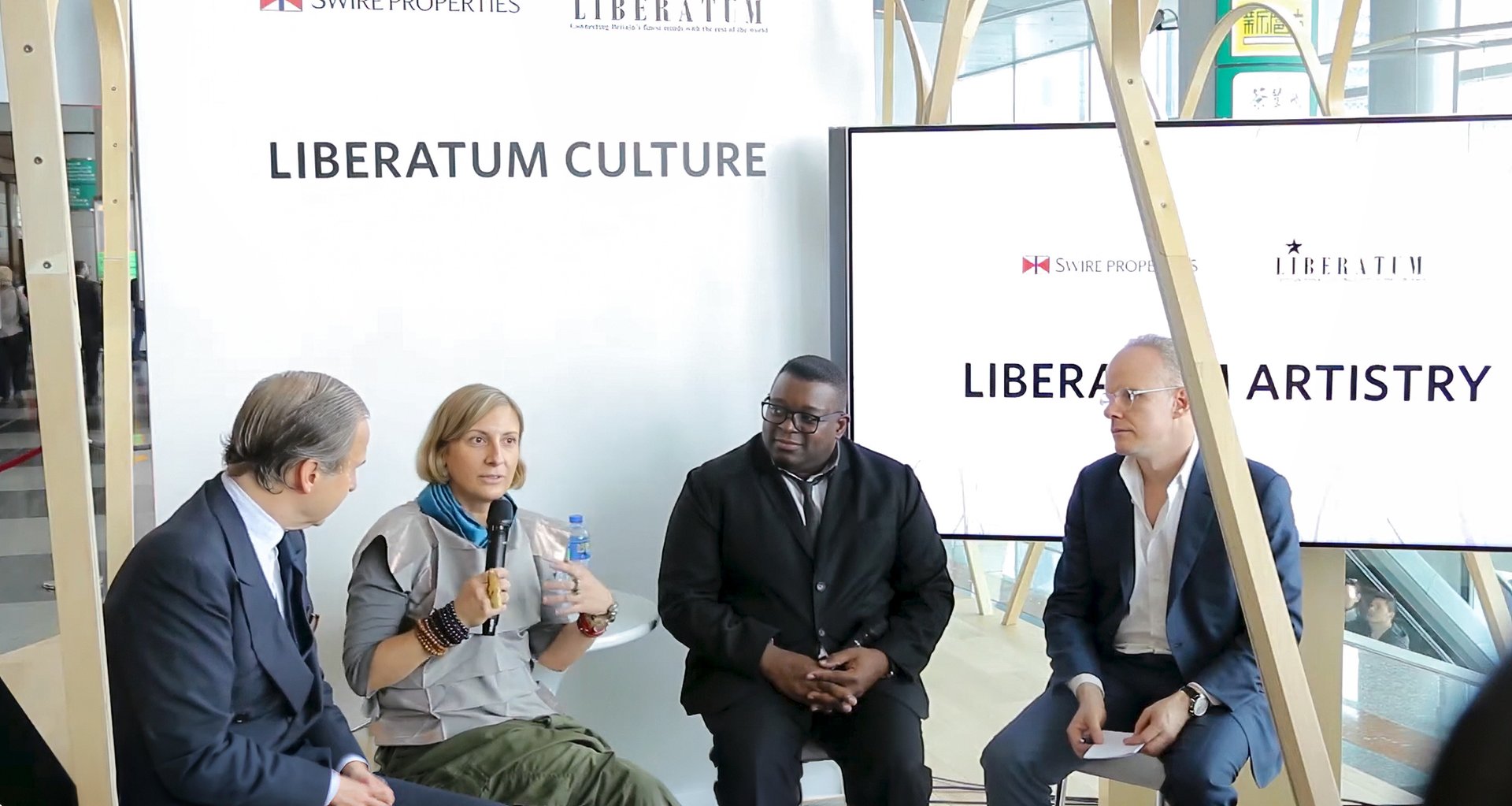
Liberatum Artistry – Salon: Liberatum Culture | Hong Kong 2015
Panelists:
Grimanesa Amoros, Isaac Julien, Hans Ulrich Obrist
Event Host:
Simon de Pury
Liberatum is an international cultural diplomacy organization, multimedia platform, and cultural content producer founded by Pablo Ganguli in 2011. Dedicated to promoting arts and culture worldwide, Liberatum creates inspiring and innovative content while organizing global programming that connects some of the finest minds and most acclaimed creative leaders of our time.
The organization is known for presenting multidisciplinary artistic platforms that merge diverse art forms and encourage collaboration across cultures. Through its events and initiatives, Liberatum fosters dialogue, innovation, and cultural exchange, highlighting the transformative power of art in addressing global challenges.
Liberatum’s upcoming event is an exciting three-day program that showcases the power of artistry and innovation. Held at the Swire Properties Lounge during Art Basel, the event will feature a series of programmed talks, panel discussions, and interactive sessions with some of the most influential figures in the art world.
Featured Panelists and Discussions
The event will bring together a diverse group of thought leaders, including:
-
Hans Ulrich Obrist, curator and Director of Exhibitions and International Programmes for the Serpentine Gallery, will explore the impact of technology on creativity in today’s world.
-
Grimanesa Amorós, a Peruvian-born American interdisciplinary artist known for her large-scale light installations, will share insights into her creative process and the intersection of art, technology, and cultural identity.
-
Isaac Julien, an English installation artist and filmmaker, will discuss the role of multimedia art in shaping contemporary narratives.
(3:14) First, I want to say thank you very much to our Liberatum for giving me the opportunity to be with wonderful panelists and for you, that you have taken some of your precious time to come and hear all that we have to say. So thank you for that. Well, it’s an interesting question. Where do we start? I’m originally from Peru and I came to New York when I was 20 years old with two bags and a dream about living the bohemian life that we all see in the movies growing up in Peru, you see? So that’s when I started in 1984 and it has been a very interesting path.
(4:31) Well, I think that from the start I was not really interested in making work that perhaps was going to be doing very well in the art market. I want to start by saying that. And so I never felt that I wanted to make work and to be displayed in a home basically as a trophy.
(5:12) And it just made me say, wow, I couldn’t sleep the whole night. And I said, if I could only share this experience with others, wouldn’t it be amazing? So it took me a little while to try to transfer that experience from those moments until when I started using the technology, of course. And first I started with theater lighting.
(5:31) And it made me realize that I didn’t want to have a business in maintaining the pieces because they get very hot and then you have to constantly change the gels. But at that time, the LED world was quite, you know, the patches required to be quite expensive. So I had to wait a couple of years.
(5:52) And now mainly what I do is I create work with an engineer that they make what we call these DMX-32s and I could program regular LED lightings that, for example, architects or engineers will use on their regular buildings, the ones that you just see every day, basically. And the only difference is that I create a little brain that I am able to manage them and do certain movements, what I would like them to do at that time. So clearly technology does play an important role in your work and for your way of expressing yourself.
(17:37) I really don’t think that the physicality will disappear. I think that a lot of people are attached to objects, they want them.
(17:47) So I think that we might not be able to see it in the next 50 years. I feel that there is a tremendous sense of robotics and that a lot of scientists are romancing the idea of movements and I think it’s going to be incorporated into the human being to be part of robotics. That is something that is very, very interesting to the person, the human being, become an object of itself, of technology and become an object itself.
(18:18) So I don’t think that it’s going to be disappearing. Now, for myself, I like to work with light because it’s very ephemeral. And so you cannot catch the moment of the light because it changes every second.
(18:35) And at the same time, I use the physicality of certain materials that are common use for everyday to be able to transmit the light through it. Right? So I don’t… I see, for example, my daughter, she’s 18 and she, of course, uses Instagram and Facebook but I see how much still she loves to go, for example, to the museums and how she looks at old masters to appreciate composition and colors and so on. So I… It’s a very big… I think we are at the beginning of it.
(27:55) Well, it is true, actually. In some places, like in Spain, they are very, very active with tweeting. I was blown away because most of my installation work is actually interactive. I want the public to go through the lights and experience.
(28:11) So normally they are open, but in a project I did with the Minister of Culture in Spain, I guess they are very active with tweeting. And the first week, they went over 7,000 people. So how they prepared a space that was all tunnel and not being in risk of being sued by insurance and people falling and taking all the pictures with the guards.
(28:39) So unfortunately, it brings pros and cons like anything else in life because I have to… And it’s not the first time. Somehow it had to be closed because they wouldn’t be allowed, the installation to be massively open. And so it’s a way to… That’s one in a country that I didn’t have that feeling in the States, for example, with tweeting.
(29:06) Now, I’ve got to say that most of us, we are limited on our knowledge of technology by the companies that they want to sell certain amount of products because I have the experience to work directly, especially with a lot of LEDs companies that they want me to work with them with their softwares. And so a lot of times I say, well, you know, we are so many far advanced. Why you keep on having that in the markets? And it’s that, listen Grimanesa, is that we have certain amount of product, we have to finish them, and then we go to develop the next, even though we are three other steps over.
(29:46) So in a way, for the majority of all, where knowledge of technology somehow is limited by the corporations that they want to let us know at a certain point and not right after, right? So that’s something to put.
(35:36) Actually, I disagree. I think we are all artists in a way. We just use different ways of expression.
(35:48) I mean, you know, some people, you know, even to be a businessman, a good businessman, you have to be creative. So a good businessman could call himself an artist. What is art, then? Well, let’s say it depends on each individual.
(16:04) You know, I cannot answer what is art. I could tell what works for me, you know, what has been working, but I cannot have a general idea of what is art.
(36:21) It’s so broad.
(43:49) Well, books are obviously very important for all of us, but in my case, I have boxes and thousands of hundreds of books and I just love the physicality of feeling surrounded by them. And I don’t think that’s going to be changing.
(44:10) I think it’s going to be a very big audience all the time, very avid audience, to keep on looking for books in different areas, of course, and obviously in technology. I get approached a lot by doing, actually, books online, magazines online, a lot. And also, I’ve got to say that in my case, you could understand, always surrounded by power supplies and all this electrical hardware around me.
(44:39) And sometimes, you know, I like to disconnect a little bit and go where Hans was talking about, about just writing. I have extensive notebooks that now I’m keeping, but before, I used to fill them up and then just throw them out until my sister, you know, I realized that she started collecting them and so I thought it was very interesting. So I do write, you know, I don’t know in the case of Isaac, but I write in the mornings and every night.