
Grimanesa Amorós Turns Light Into Performance
by The AWT (A Women’s Thing) Editors
May 5, 2026
Nearly a decade after our first collaboration, we return to Grimanesa Amorós.
We begin with “RADIANCE,” her recent work with the Los Angeles Philharmonic at Walt Disney Concert Hall. Built in dialogue with music, the piece unfolds live. It is shaped by timing, intuition, and the conditions of the moment.
In this conversation, Amorós speaks about working with light as performance, composing in real time, and the tension between control and surrender. This is the first in a series, with two further features to follow.
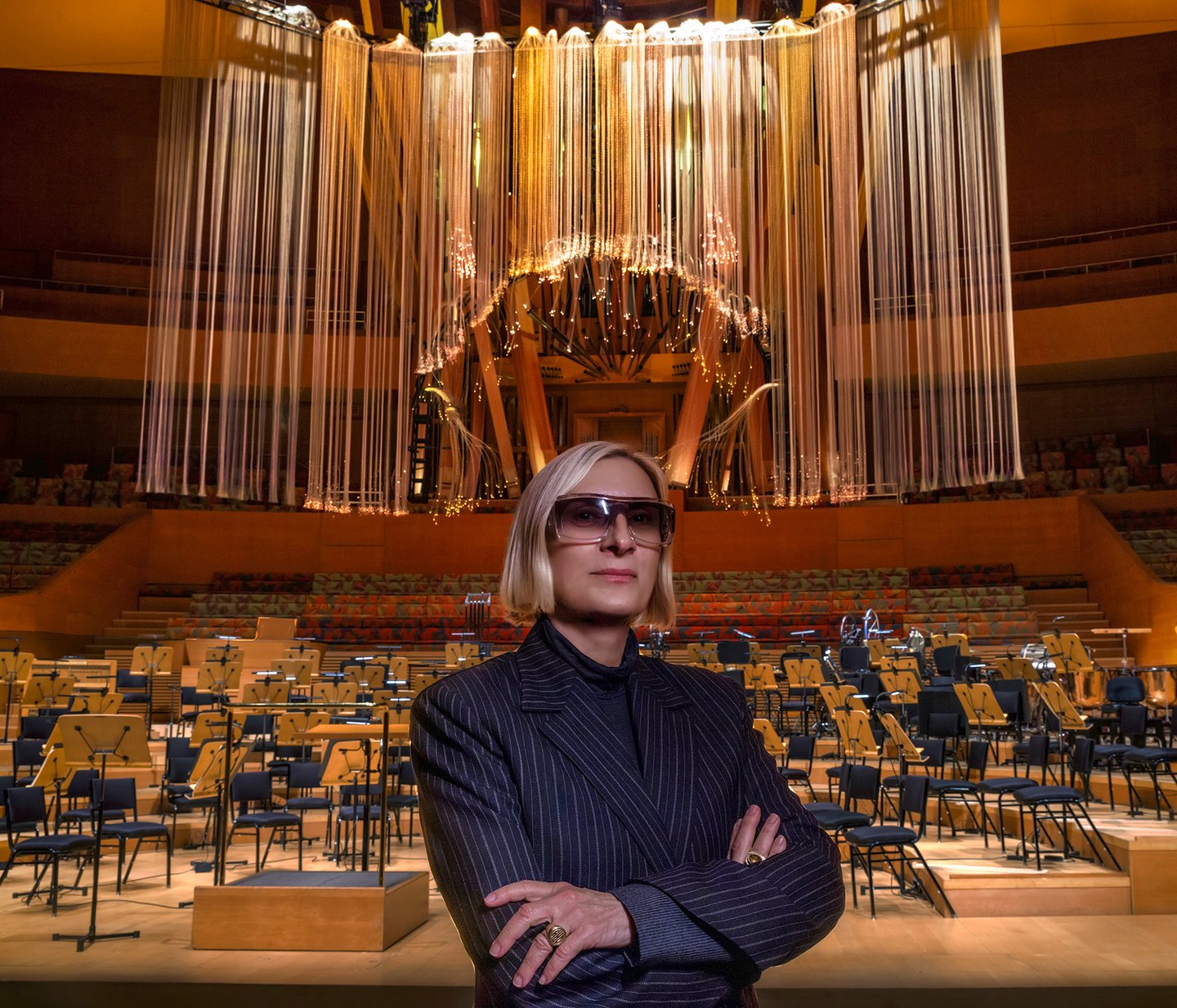
LA Philharmonic, Walt Disney Concert Hall.
Courtesy Grimanesa Amorós Studio.
The Romance with the Unknown
It has been a long time since we last spoke. When you think back on the pandemic years, what do you remember most about that time?
Grimanesa Amorós: It was an interesting time, because although we were confined, I was busy creatively; unsurprisingly, it was an outlet. What I remember most was the silence and how much it made me reflect on connection and presence. It also gave me the time to work on research and development for my smaller works, a series called “CAPPED WAVES.”
As someone who works with public space and human interaction, the pandemic reminded me how precious light is, like the sunsets we watched from our windows, which kept us going for the next day. Even though we were physically apart, we could all share the sunset, all share the light.
You have to surrender to the romance with the unknown.
It provided me time to connect with my community in a different way. I was participating in online lectures, podcasts, and conversations, and finishing installations; they were already underway and required completion.
My studio was never closed. Although the world was paused, we kept moving.
In “Radiance,” your light cues are timed to live music. What did you do first in the studio to get that timing right?
Amorós: I don’t read music, but Alexander Scriabin was diligent in his vision, and marked what notes correspond to which colors, and with the help of a collection of notes, I was able to understand the moments that required more power or softer lighting. I program on sight, so my first practices were live and in person during rehearsals. To get the cues right, I worked with an assistant conductor on my last day of rehearsal to guide me through the music and ensure the moments I marked in my annotations were in sync with it.
My programming is like painting. Every moment, shift, and sensation is chosen by me.
This sequence was performed live, no loop or timing the music, but quite literally during the performance, based on the musicians’ and Esa-Pekka Salonen’s speed, the conductor of the LA Philharmonic. It was challenging, or how I like to call it, a true romance with the unknown, but a wonderful success.
Flexibility and creativity are the keys to success when on-site. You have to surrender to the romance with the unknown.
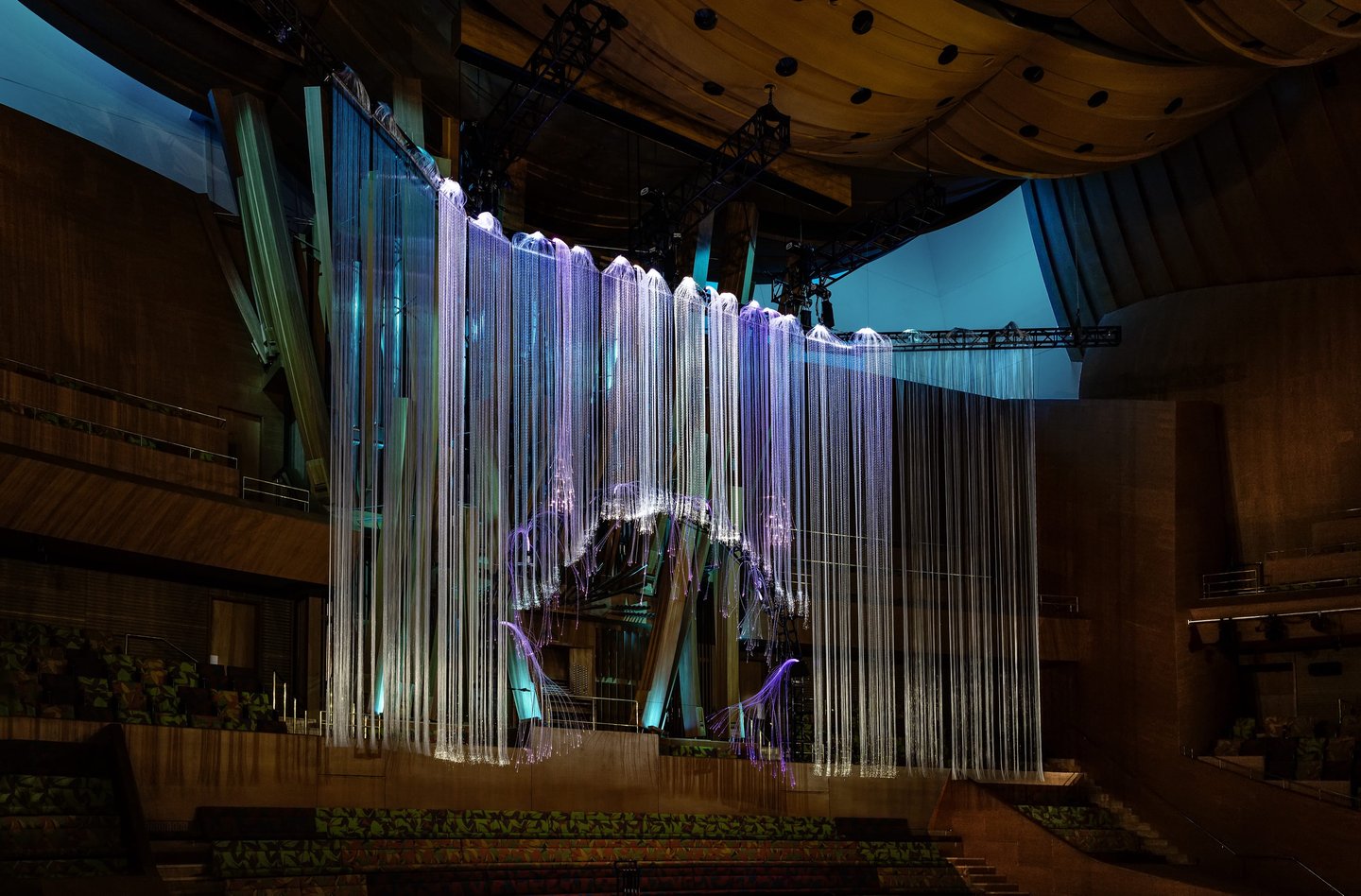
LA Philharmonic, Walt Disney Concert Hall.
Courtesy Grimanesa Amorós Studio.
Grimanesa Amorós on Ephemerality
“RADIANCE” was only up for a few nights. Did that change how you designed it?
Amorós: I am not a designer; I am an artist who creates and works with light as my medium. My work is an expression of my artistic essence.
The only aspect that changed for me was my awareness of time. Each installation is unique. In this case, I was given three days for installation and rehearsal, followed by three performances. With the LA Phil’s efficient team, we brought my vision to life seamlessly. Because I had just two days to program an hour and a half of content, the process was intense but energizing. Everyone understood it was a one-time, ephemeral event, which heightened the performance.
The installation fits the hall so well. Did you ever imagine it living there longer?
Amorós: I couldn’t agree more! It felt like it was meant for the space. When I create installation artwork, I intentionally engage with the architecture, the space, and the viewer so it all becomes one.
Building on that, I also respect temporary installations for their power. They exist only for a moment, which emphasizes light’s ephemerality. A memory can hold strong permanence. Creating art that makes a mark on experience is a successful installation. “RADIANCE” was a performance that people knew was unique, a moment only they would witness and remember. The next performance would be entirely different, never repeating, always respecting temporality.
This project reinforced my commitment to creating impactful moments. I look forward to the next musical collab.
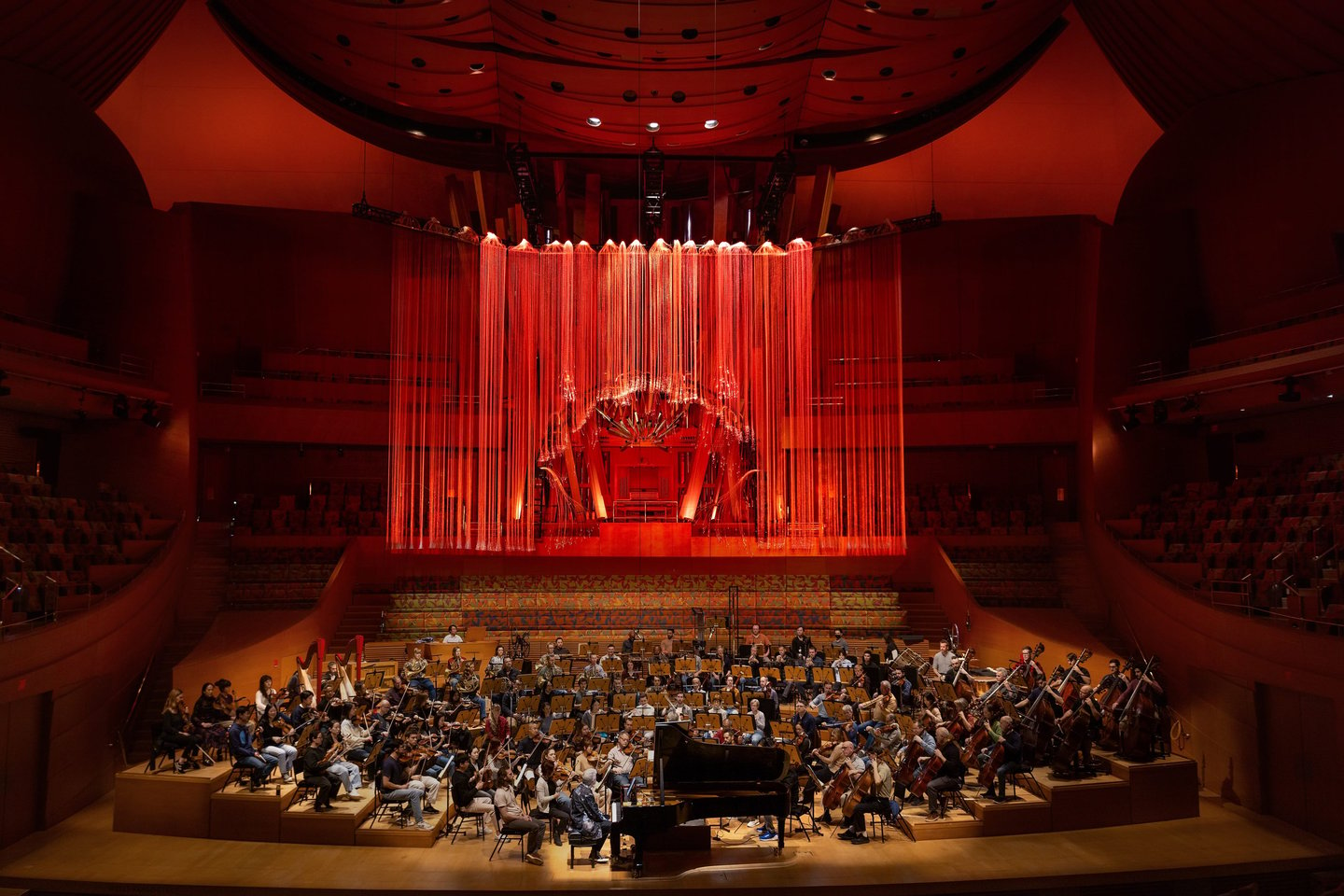
LA Philharmonic, Walt Disney Concert Hall.
Courtesy Grimanesa Amorós Studio.
Disney Hall has its own visual language. What drove your decisions there?
Amorós: I have always loved Frank Gehry’s architecture. My goal was to remain respectful of the space and have the art engage with its surroundings. The organ, unique and beautifully created, became an integral part of the sculpture. This allowed the lighting sculpture to enter the world of music and honor Frank.
I wanted the work to feel as though it belonged in the space, connecting respectfully rather than imposing.
Prometheus and Viracocha are part of the thinking behind “RADIANCE.” What was the first image you had when you started?
Amorós: The first word that comes to mind is power. Knowledge, like fire, brings power.
Both Prometheus and Viracocha reflect creation through the transformative power of light, which both creates and renews.
Light exposes darkness and brings clarity. That is how I see “RADIANCE,” a work of art that transforms how we experience and move through a space using light.
Light’s ephemeral nature is powerful.
In an earlier interview with us, you mentioned solving the hard technical problems in advance so the install can feel calm. For “RADIANCE,” what were the key things you needed to lock before arriving on site?
Amorós: The challenge was the timing of the sequence. The other was programming. With so little time, every second during rehearsal was precious. I custom-create my lighting colors, and programming can usually take a week or more. Here, I had two days, and I always make it happen. Although it is high-pressure to perform the sequence live, like the music, you get into a rhythm. Then, suddenly, the moment feels calm and intentional. That is when I connect with the unknown and let it inspire me. This is how I ensure the artwork experience is seamless.
Composing Light for “RADIANCE”
When you say you are composing a lighting sequence, what does a normal workday look like while you are building it?
Amorós: First, like a painter, I create my colors, not from an algorithm or tube. Then, I must understand the space and feel how I can move you within it. From there, I create because, as another human, I know what can move you and inspire you. I select each second myself, with no shortcuts or remixes. My programming is like painting. Every moment, shift, and sensation is chosen by me as I develop my sequence.
What is the hardest part of the learning curve when working at this scale?
Amorós: You can always be expertly prepared. Yet you still require creative problem-solving for monumental sculptures. At this scale, there are many moving parts; sometimes you must adapt in the space.
If I capture their attention, make them think, take a second of their time, I have done my job as an artist.
You’ve said you are exploring AI. Has it become useful in your studio, or is it still more of a question than a tool?
Amorós: It is more of a playmate! I don’t apply it to my physical work because the sequences are created by me, second by second, and the installation.
AI has advanced my research exponentially when exploring my next topic or source of inspiration. Authorship still comes from a human; technology is assisting the process, but it doesn’t have a soul. It’s the soul and energies that create artwork.
When someone walked out of the hall after seeing “RADIANCE,” what did you hope would stay with them?
Amorós: If I capture their attention, make them think, take a second of their time, I have done my job as an artist, to stop and make people think differently. That is always my goal with my artwork.
Featured image: Grimanesa Amorós “RADIANCE,” LA Philharmonic, Walt Disney Concert Hall. Courtesy Grimanesa Amorós Studio.
Read the full article here: https://awomensthing.org/blog/grimanesa-amoros-radiance-interview/